



Quran Academy Online
June 16, 2020
1

What is Surah Mulk good for?
One of Surah Mulk benefits when you recite Surah Mulk before sleeping, an angel comes to protect you, because when a person sleeps, he is unable to protect himself.
What is Mulk in Islam?
The name Mulk (Arabic
writing: مولك) is
a Muslim boy Names.
The meaning of the name Mulk is
" Kingdom, sovereignty, supreme.
Which Para has Surah Mulk?
Surah Mulk recite
with text surah number
67 para 29.
When should we read Surah Mulk?
According to authentic hadith… Surah Al Mulk can be recited after the completion of Maghrib prayer(4th prayer in a day)… and can be also recited after Isha prayer.
It is also known as surah al tabarak.
It is recited for ease of sustenance in the grave after death.
What are the other names of Surah Al-Mulk? Explain these names?
Tabarak and Al-Munajiah. Tabarak means Allah is great and full of blessings. Al-Munajiah means savior.- it helps prevent committing sins and it saves people from punishment in the grave.
 What are the two
verses of the Surah Al-Mulk in the Quran?
What are the two
verses of the Surah Al-Mulk in the Quran?
The first two
verses from Surah Mulk are:
“Blessed is He in Whose Hand is the dominion, and He is Able to do all things. Who has created death and life, that He may test you which of you is best indeed? And He is the All-Mighty, the Oft-Forgiving.”
Why is Surah Al Mulk important?
Quran is the greatest blessing of Allah which he has bestowed upon mankind. There is 114 Surah of the Holy Quran and each Surah is a light that alters our lives and shows us the right way to live.
Surah Mulk is Makki Surah. Al Mulk
means "The kingdom" or "the Dominion" of
almighty Allah. It was revealed on the Last Prophet Muhammad PBUH in Mecca. It is
67th chapter of the Holy Quran. It has thirty verses and in the 29th Para of the Quran.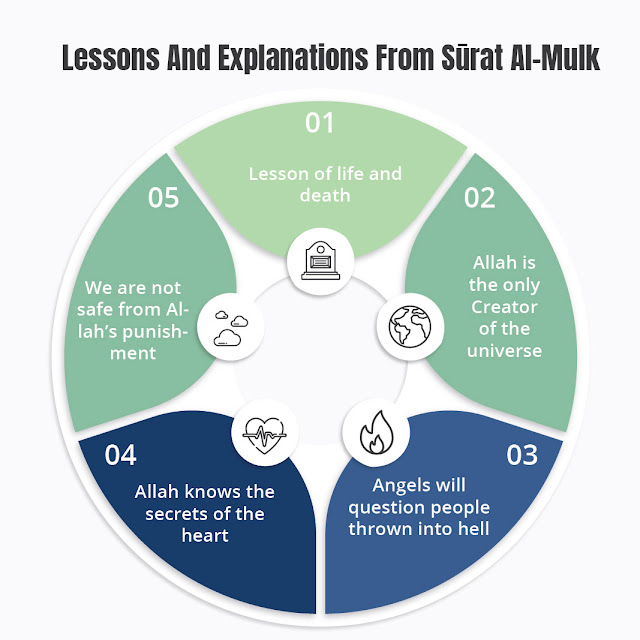
Does Surah Mulk's
protection punishment grave?

And each time this Surah will defend him by saying, 'You cannot do anything to him, he used to recite Surah Mulk'. ' Abdullah ibn Masud further states, 'It is called, 'Al-maani'ah'. For it protects from the punishment of the grave.
 When is the Surah al-Mulk recited?
Surat al-Mulk is one of the great surahs of the Qur’an which we are encouraged in Saheeh reports to recite frequently, and there are reports which say that it will protect the one who recites it from the punishment of the grave.
Abu Dawood (1400) and al-Tirmidhi (2891 – and he classed it as Hasan) narrated from Abu Hurayrah that the Prophet (blessings and peace of Allah be upon him) said: “There is a surah of the Qur’an, with thirty verses, that interceded for a man until he was forgiven; it is ‘Surah Tabaarak Alladhi bi yadihi’l-Mulk (Blessed is He in Whose Hand is the dominion)’ [al-Mulk 67:1].” It was also classed as Hasan by al-Albaani in Saheeh at-Tirmidhi.
Al-Mannaawi (may Allah have mercy on him) said:
He recited it frequently, thus it kept asking Allah (to forgive him) until he was forgiven. This is the encouragement to everyone to recite it regularly so as to attain its intercession.
In the virtue mentioned, that this surah will intercede for the one who recites it, there is nothing to limit recitation thereof to night or day, rather what may be understood from this hadeeth is that what is meant by reciting this surah is paying particular attention to it, memorizing it, understanding it, and reciting it frequently, especially in prayer.
According to the hadeeth of Jaabir (may Allah be pleased with him), the Prophet (blessings and peace of Allah be upon him) did not sleep until he recited Alif-Laam-Meem tanzeel (Soorat as-Sajdah) and Tabaarak alladhi bi yahihi al-Mulk (Surat al-Mulk).
There is the hope that the one who recites this surah will attain this great virtue and it will intercede for him before Allah s.w.t and save him from the punishment of the grave. There are reports which speak in particular about giving extra attention to it at night or when going to sleep. So if a person strives to do that, it is a good thing, Insha Allah.
Why did Prophet Muhammad ask to recite Surah Al-Mulk (Chapter-67) every night before going to sleep?
Surah Mulk is a Makki Surah with thirty verses and its rewards are not fixed for a certain time in a day, you can recite it as many times you wish to in a day. Specifically, if you recite Surah Mulk before sleeping, Allah sends down Angels to protect you from any harm. As a Muslim, we all know that there is only one Surah in the Holy Quran which will plead Allah to forgive its reciter and this is Surah Mulk.
Abu Hurairah reports about Messenger of Allah PBUH, I heard Holy Prophet PBUH said,: There is a Surah in the Quran contains thirty Ayat which kept interceding for a man until his sins are forgiven.
This Surah is
�Blessed is He in Whose The hand is the dominion.
� (Surah Al- Mulk 67).
� (Al- Tirmidhi and Abu
Dawud).
Hadith which says that Prophet peace is upon him used to recite Surah al-Mulk every night. Abdullah bin Mas‘ud narrates that “whoever recites Surah al-Mulk every night, Allah will prevent the punishment of grave by this Surah”.
As a Muslim, we all know that there is only one Surah in the Holy Quran will plead Allah to forgive its reciter and this is Surah Mulk.
What is the authenticity of the virtues of reciting Surah Mulk and its protection from the hellfire?
Abu Hurairah narrated that Allah’s Messenger (ﷺ) said:



 Welcome to Quran Learning and Recitation Blog